
Technology is changing how companies operate, compete, and serve customers faster than most leadership teams expected. Across the United States, organizations that once relied on manual workflows and disconnected software are adopting artificial intelligence, automation, cloud computing, and connected platforms to stay relevant.
Digital innovation in business is no longer a luxury reserved for large enterprises. US companies use it to improve operational efficiency, reduce costs, and respond to rising customer expectations for speed, personalization, and convenience. Customer service, financial management, supply chains, marketing, and internal communication are all being reshaped by digital tools that work faster and more accurately than legacy processes.
Investing in scalable technology matters because markets move quickly and customers rarely wait. Solutions that grow with the business protect earlier investments and make future expansion easier. Still, buying software alone does not create results. Businesses that combine technology adoption with strategic planning, clear goals, and trained teams will be better positioned to adapt to future market demands. This guide explores the technologies, industries, risks, and strategies that will define the year ahead.
Understanding Digital Innovation and Why It Matters for Modern Businesses
What Is Digital Innovation in Business?
Digital innovation is the application of modern technologies to improve business processes, products, services, and customer experiences. It differs from basic digitization, which simply converts paper records into digital files, and from digital transformation, which reshapes major operations around technology. Continuous digital innovation goes further by treating improvement as an ongoing habit. Businesses are moving beyond replacing manual steps with software and building connected, intelligent ecosystems. Automated customer support, digital payment platforms, cloud collaboration, and AI-powered analytics show how this works in practice. The goal is not novelty for its own sake but measurable improvement.
Why Digital Innovation Is Becoming a Business Priority
Competition pushes organizations toward faster, more flexible operating models. Customers expect personalized services, convenient digital experiences, and quick responses. Automation reduces repetitive work and lifts workforce productivity, which is why technology investment now matters for startups, small businesses, and large enterprises alike. Rising labor costs and tighter margins add pressure, making efficiency gains harder to ignore.
The Connection Between Innovation and Long-Term Growth
Modern technology helps businesses enter new markets, while integrated platforms improve coordination between departments. A retailer expanding into a new state, for example, can rely on shared inventory and customer data instead of rebuilding systems from scratch. Likewise, finance and operations teams working from one source of truth make faster, more consistent decisions. Investments that support scalability also build operational resilience, allowing companies to handle disruption without losing momentum.
Artificial Intelligence Is Transforming Business Operations
AI-Powered Automation for Everyday Business Activities
Artificial intelligence now handles repetitive, time-consuming tasks such as invoice processing, appointment scheduling, customer inquiries, document management, and data entry. Automation reduces manual errors and frees employees to focus on higher-value work. Retail businesses can update inventory automatically as sales happen, while financial organizations can streamline transaction monitoring and flag unusual activity for review. Because these tools run continuously, work that once waited for the next business day can now finish in minutes, improving both speed and consistency across teams. Employees also tend to feel less frustrated when routine tasks leave their workload.
Generative AI and AI Agents Are Changing Workplace Productivity
Generative AI supports business communication, software development, research, marketing, and content production. AI agents take this further by completing several connected tasks with appropriate permissions and human oversight. Companies can integrate these capabilities into CRM, ERP, and customer service platforms so assistance appears inside the tools employees already use. Used well, these tools shorten drafting time, speed up research, and give small teams the output capacity of much larger ones. However, teams should always review AI-generated outputs for accuracy, security, and reliability before relying on them. Clear usage guidelines keep experimentation productive and safe.
Predictive Analytics for Better Business Decisions
AI analyzes historical and real-time data to identify patterns and predict likely outcomes. Common uses include demand forecasting, customer behavior analysis, sales predictions, and equipment maintenance. These insights help management teams make informed operational and financial decisions. A manufacturer, for instance, can schedule maintenance before a machine fails rather than after production stops. That shift from reacting to anticipating is where predictive tools deliver the most value, reducing surprises and protecting margins. Predictions are only as good as the inputs, so accurate data, responsible AI practices, and human judgment remain essential.
Cloud Computing and Connected Technologies Are Creating Smarter Enterprises
Cloud Computing for Flexible and Scalable Business Infrastructure
Cloud computing lets businesses use applications, storage, and computing power without maintaining every server locally. Public, private, and hybrid environments each suit different needs for cost, control, and compliance. Cloud systems support remote work, cross-location collaboration, and expansion, although flexibility requires disciplined cost management and strong security controls. Many US companies start with a single workload, such as email or file storage, and expand gradually as confidence grows.
Internet of Things and Real-Time Operational Intelligence
The Internet of Things (IoT) connects devices that collect and exchange business data. Practical uses include manufacturing equipment monitoring, warehouse management, fleet tracking, healthcare devices, and smart buildings. Real-time information helps teams spot operational problems early and use resources more efficiently. A logistics company, for example, can track vehicle location and condition together, reducing delays and unplanned repairs. When IoT data flows into cloud platforms, businesses gain more responsive environments.
Enterprise System Integration
Connecting CRM, ERP, financial, inventory, and operational platforms reduces isolated databases and improves information sharing. API integration creates seamless workflows across departments, so a sale recorded by one team updates inventory, billing, and reporting automatically. Without this connection, employees waste hours re-entering the same information and reconciling conflicting records.
Cybersecurity and Digital Trust Will Shape the Future of Business
Understanding Cybersecurity Risks in a Connected Business Environment
Greater dependence on digital platforms creates new security challenges. Ransomware, phishing, credential theft, insider threats, and unauthorized access are among the most common dangers. A data breach can damage customer trust, interrupt business continuity, and harm reputation for years. Attackers increasingly target smaller firms precisely because their defenses tend to be weaker. For that reason, cybersecurity belongs in the planning stage of digital transformation rather than being added afterward.
AI-Driven Security and Continuous Threat Monitoring
AI-powered security systems identify suspicious activity and unusual network behavior far faster than manual review. Security Operations Centers (SOCs) monitor networks, investigate incidents, and coordinate responses. Continuous monitoring, including a 24/7 soc service dubai model that provides round-the-clock threat detection, helps businesses catch problems before they cause significant damage. Rapid response times matter because the hours after an intrusion often determine how costly it becomes. The strongest approach combines automated detection with experienced cybersecurity professionals who can judge context and respond decisively.
Data Protection, Compliance, and Building Customer Trust
Encryption, identity management, multi-factor authentication, and access control form the foundation of data protection. US businesses must also consider privacy and industry-specific regulations, including HIPAA for healthcare organizations and relevant state privacy laws. Professional support such as cybersecurity services dubai can assist with vulnerability assessments and enterprise data protection. Documented security policies and tested incident response plans further strengthen long-term digital trust. When customers see that their information is handled carefully, loyalty follows naturally.
Industry-Specific Digital Innovation Is Transforming Traditional Business Models
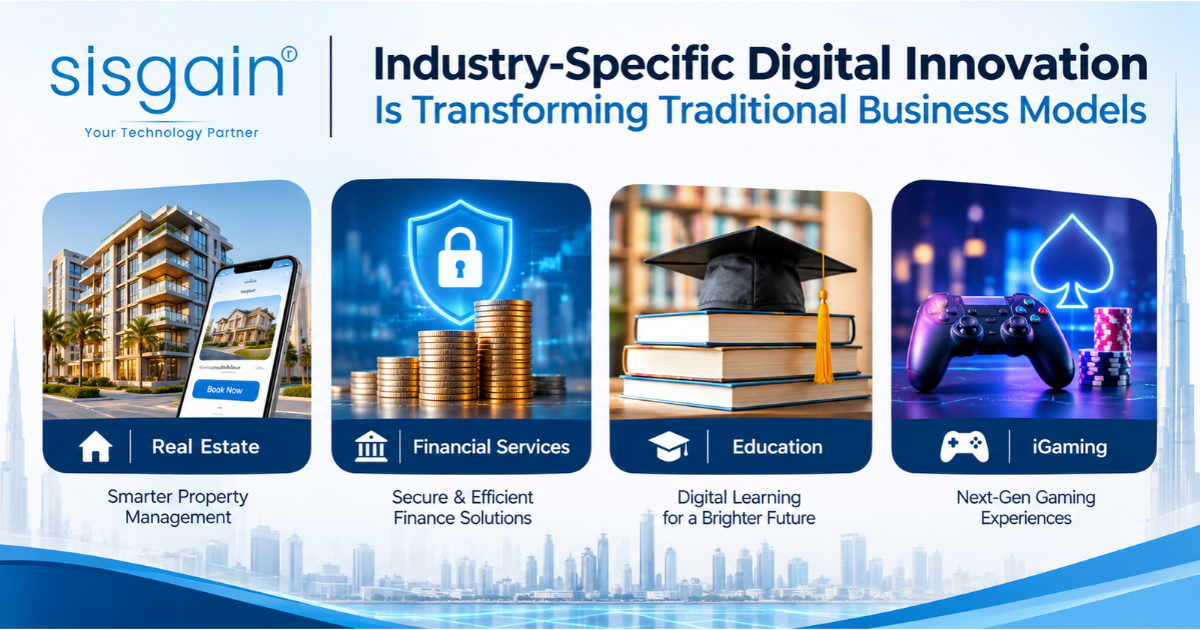
Real Estate
Digital platforms are transforming how people buy, sell, rent, and manage property. Mobile apps let customers browse listings, schedule visits, submit inquiries, and chat with agents. Virtual tours, digital documentation, online payments, and automated maintenance requests remove friction for everyone involved. Property management platforms also improve communication between owners, tenants, and service providers. Tenants appreciate transparent communication, and owners benefit from clearer reporting on occupancy and maintenance costs. Companies investing in real estate app development services can build customized property applications and integrated management platforms, while data analytics reveals market demand and customer preferences. The result is a smoother experience from first search to lease renewal.
Financial Services
Banks, lenders, and everyday businesses are adopting digital platforms to improve financial operations. AI-powered fraud detection, automated accounting, digital payments, and financial reporting reduce errors and save time. Integrated applications help organizations monitor transactions, manage budgets, and improve reporting accuracy, but secure infrastructure and regulatory compliance remain non-negotiable. Automation of reconciliation and reporting also shortens month-end close cycles. Specialized organizations can benefit from financial software consulting, which supports financial system integration, customized applications, and technology planning for financial operations. Customized software also fits unusual workflows that off-the-shelf tools handle poorly. Real-time visibility into cash flow supports faster, better-informed decisions.
Education
Schools and universities are moving toward integrated learning and administration systems. Learning management systems, student information management, online examinations, attendance tracking, and digital communication keep daily operations organized. AI can personalize learning recommendations and automate administrative work, while better coordination links teachers, students, parents, and administrators. Parents gain easier access to schedules, grades, and announcements without visiting the office. An education management system dubai approach to integrated school administration and digital student management shows how unified platforms reduce paperwork. Accessibility, data privacy, and reliable infrastructure must remain priorities. Inclusive design ensures every learner can participate.
iGaming
Mobile technology, cloud computing, and real-time interaction are reshaping online gaming. Scalable infrastructure, personalized interfaces, and performance optimization keep players engaged. Cloud scalability helps platforms handle traffic spikes during major sporting events. Secure transactions, identity verification, fraud prevention, and responsible gaming features are equally important. Spending limits and self-exclusion options also protect vulnerable players. Platforms operating in the United States must also respect state-specific licensing and regulatory requirements. Working with an igaming development company dubai can help organizations build specialized gaming applications on advanced, secure, and user-friendly platform infrastructure. Lag, downtime, and weak security quickly drive users away, so technical quality directly affects revenue.
Data Analytics Is Creating New Competitive Advantages
Converting Business Data into Actionable Insights
Organizations collect data from websites, mobile apps, customer interactions, and internal systems. Business intelligence dashboards, performance tracking, and predictive reporting turn that raw information into clear views of progress. Real-time analytics reveals inefficiencies and improves operational planning before small problems grow. Leaders no longer need to wait for monthly reports to see what is happening.
Personalized Customer Experiences Through Data
Studying customer behavior reveals preferences and purchasing patterns. Personalized recommendations and targeted communication boost engagement, while the same insights help organizations improve retention and service quality. A subscription business, for example, can spot customers losing interest and reach out with relevant offers. Relevance builds loyalty far more effectively than generic mass messaging.
Responsible Data Management
Accurate data, strong privacy practices, governance, and carefully assigned access permissions keep analytics trustworthy. Organizations need structured policies for collecting, storing, and processing business information, because insights built on poor data lead to poor decisions. Regular audits help teams catch errors and outdated records early. Clear ownership of each dataset prevents confusion.
Major Digital Transformation Trends Businesses Should Prepare for in 2027
Autonomous AI and Intelligent Business Agents
AI agents are progressing from basic chat interfaces toward systems that handle multi-step workflows, analyze information, and support business decisions, always within defined limits and with human review. Expect them to appear inside everyday business software.
Hyperautomation Across Enterprise Operations
Hyperautomation combines AI, robotic process automation, and workflow management to streamline repetitive activities across departments, from onboarding new hires to processing claims. Connecting automation tools, rather than running them separately, multiplies the savings. Teams then spend time on exceptions that truly need judgment.
Advanced Cybersecurity and Digital Identity
Identity-first security, automated threat detection, continuous authentication, and improved access management are becoming standard as perimeter-based defenses lose relevance in distributed work environments. Verifying every user and device, every time, limits the damage from stolen credentials.
Edge Computing and Real-Time Processing
Edge computing processes information closer to connected devices, supporting faster responses in manufacturing, transportation, healthcare, and smart infrastructure, where even small delays can be costly. It also reduces bandwidth use by filtering data before it reaches the cloud.
Sustainable and Resilient Technology Infrastructure
Energy-efficient computing, responsible cloud resource management, infrastructure resilience, and long-term sustainability strategies help businesses lower costs, meet stakeholder expectations, and stay operational during disruptions. Efficiency and resilience increasingly go hand in hand. Planning for outages, power constraints, and supply disruptions now prevents costly surprises later.
Challenges Businesses Must Overcome During Digital Transformation
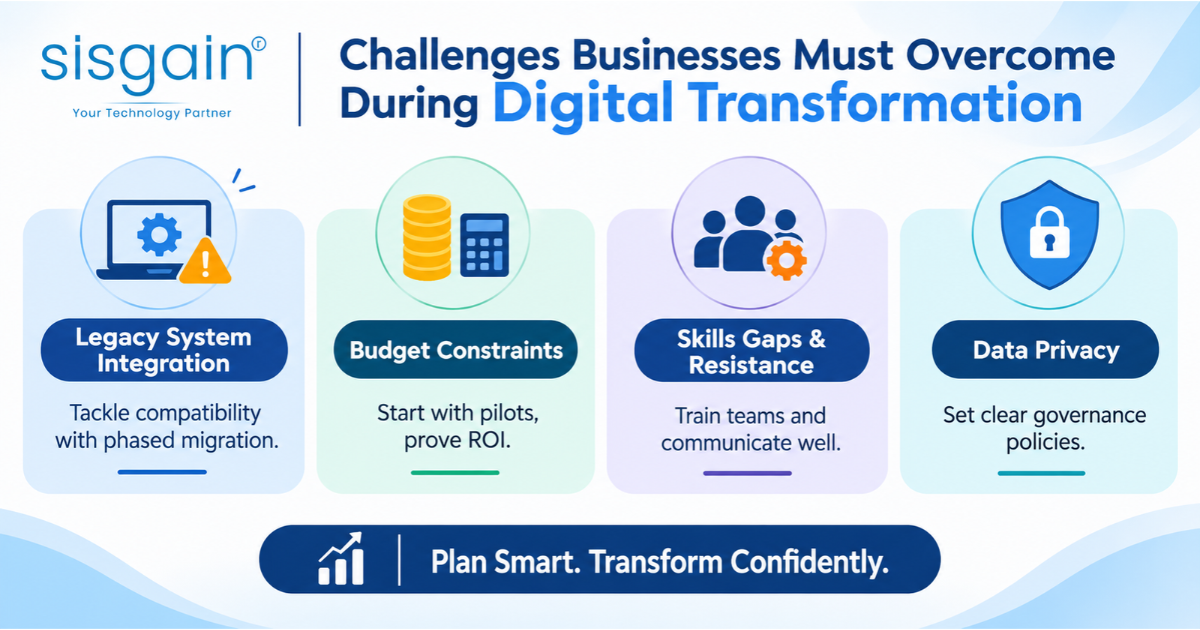
Legacy System Integration and Technical Limitations
Older software often clashes with modern technologies, causing compatibility problems. Phased migration, API integration, and thorough system testing reduce risk and keep operations running during the transition. Replacing everything at once is rarely realistic. Testing in stages catches issues before customers notice them.
Budget Constraints and Uncertain Returns
Implementation, licensing, training, and ongoing maintenance all add up. Businesses should evaluate expected ROI before committing to large technology investments, starting with pilots that prove value. Small wins also build internal support for larger projects. Tracking costs against outcomes keeps projects honest.
Digital Skills Gaps and Employee Resistance
Employees may struggle to adapt to new platforms and automated workflows, sometimes fearing for their roles. Practical training, open internal communication, and sound change management turn skeptics into supporters. Involving staff early makes adoption smoother.
Data Privacy and Responsible Technology Adoption
Concerns about data access, AI accuracy, information security, and regulatory obligations are legitimate. Clear governance policies make digital adoption sustainable and keep teams accountable. Written rules about acceptable AI use prevent costly mistakes.
How Businesses Can Build a Successful Digital Innovation Strategy
Start with Clear Business Objectives
Identify operational challenges, customer expectations, and measurable goals before choosing any technology. Tools should answer defined problems, not market trends. A clear target, such as cutting order-processing time by a set percentage, keeps projects focused.
Invest in Scalable and Integrated Solutions
Choose platforms that support future growth, secure data exchange, and integration with existing systems. Scalable foundations prevent expensive replacements when the business expands or customer demand rises. Vendor support and documentation matter as much as features.
Prioritize Employee Training and Change Management
Employee involvement, technical training, and clear communication determine whether new tools are actually used. Even excellent software fails when people do not understand why it matters. Appointing internal champions helps spread confidence across teams.
Measure Results and Continuously Improve
Track productivity, operational expenses, customer satisfaction, system performance, and technology ROI to judge whether initiatives succeed. Review results regularly and refine the strategy as conditions change. What gets measured gets improved. Quarterly reviews work well for most teams.
Conclusion
AI, cloud computing, cybersecurity, automation, and data analytics are transforming businesses across every industry, from real estate and finance to education and gaming. Digital innovation is an ongoing strategy, not a one-time purchase, and organizations should prioritize scalable, secure, industry-specific solutions. US businesses that embrace responsible adoption and continuous improvement will stay competitive in 2027. Those that adapt to technological change will build stronger, more efficient, and more customer-focused businesses. The future belongs to organizations willing to learn, test, and evolve. Start small, stay secure, and keep moving.
Frequently Asked Questions About Digital Innovation in 2027
1. What Is Digital Innovation in Business?
Digital innovation in business means adopting modern technologies to improve processes, customer experiences, products, and services. It goes beyond buying software by redesigning how work gets done so the business becomes faster, smarter, and more responsive. Success is measured through results such as lower costs and happier customers.
2. How Is AI Changing the Future of Businesses in 2027?
AI is changing businesses through automation, generative AI, predictive analytics, and intelligent agents. Routine tasks run automatically, content and research happen faster, forecasts become more accurate, and agents handle connected tasks under human supervision, freeing teams for strategic work. Companies adopting it carefully gain speed without sacrificing quality.
3. Which Industries Are Benefiting Most from Digital Innovation?
Real estate, financial services, education, healthcare, manufacturing, retail, and iGaming are seeing strong benefits. Each uses technology differently, from property apps and fraud detection to connected classrooms, patient devices, smart factories, inventory automation, and secure gaming platforms. Any industry with heavy data and customer interaction stands to gain.
4. How Can Small Businesses Start Their Digital Transformation Journey?
Small businesses can begin with cloud applications, workflow automation, digital payment systems, and customer management software. Starting with one painful process, proving the value, and expanding gradually keeps costs manageable and reduces risk.
5. Why Is Cybersecurity Essential for Digital Transformation?
Digital tools expand the attack surface, so data protection, continuous monitoring, access control, threat detection, and regulatory compliance are essential. Strong security protects customers, preserves reputation, and keeps operations running when incidents occur. Security built in from the start costs far less than repairs after a breach.
6. What Are the Most Important Digital Transformation Trends for 2027?
The key trends include autonomous AI, hyperautomation, cloud computing, edge computing, advanced cybersecurity, and data-driven management. Businesses that monitor these developments and plan thoughtfully will adapt more easily as the market evolves. Prioritize trends that match your goals rather than chasing all of them.